Rummy How-To: Use a Route Score Without Chasing Precision
You do not need exact probability calculations to compare two possible rummy routes. A rough route score can organize the decision by combining completion demand, flexibility, and risk. The score is a thinking aid, not a forecast of the result.
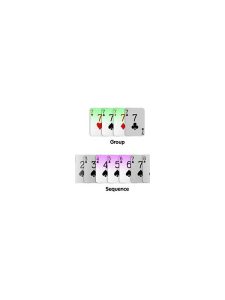
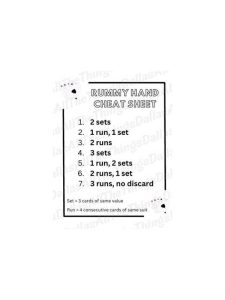
List each route separately. For example, one route may be a sequence needing a single rank, while another may be a set needing one of two matching cards. Write down the cards already committed, the number of plausible completions, and whether the route contributes to an important requirement such as a pure sequence. Keeping routes separate prevents a crowded hand from making every possibility seem equally real.
Give each route three simple ratings from one to three. Demand is low when many interchangeable cards help and high when one exact card is required. Flexibility is high when a card can change roles without damaging the plan. Risk is high when the route consumes valuable cards, leaves penalty exposed, or depends on information you do not have. You can add the first two and subtract risk, but the arithmetic is less important than the comparison.
Then apply a confidence label. Confirmed routes have a legal group already formed. Developing routes have a clear, practical completion. Speculative routes depend on a narrow draw or a chain of several future events. A route with a decent numerical score but a speculative label should not receive the same protection as a confirmed structure.
Recalculate only when something meaningful changes: a new draw, a useful discard, a visible opponent action, or a rule clarification. Constantly rescoring every card creates noise. During a turn, compare the best two routes and choose the discard that preserves the stronger overall shape. If the difference is small, favor the option that is easier to review next turn.
After practice, review whether the score helped you explain the choice. Did you notice a narrow demand? Did you account for a required sequence? Did risk push you to release a card that was merely familiar? If the score gave false confidence, simplify it and use clearer labels. The objective is disciplined comparison, not the appearance of mathematical certainty. Keep the rating scale stable across practice hands. Changing the meaning of “high flexibility” from one exercise to the next makes comparisons useless. If a route feels difficult to rate, record why; that uncertainty is itself relevant evidence.