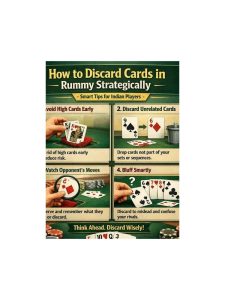
Rummy Guide: Give Every Loose Card a Job

A loose card is not automatically a bad card. It is simply a card that does not currently belong to a confirmed group. The useful question is what job that card might perform before you decide whether to keep or discard it. Giving every loose card a temporary job turns vague hope into a reviewable plan.
Start by separating confirmed groups, developing groups, and genuinely loose cards. A confirmed group already satisfies the relevant sequence or set requirement. A developing group has a connection that is plausible but incomplete. The remaining cards deserve labels such as bridge, waiting card, high-point risk, or discard candidate. These labels are not promises. They are reminders of why a card is still in the hand.
A bridge card can connect two possible sequences or support more than one route. A waiting card is useful only if one or more specific cards would complete a sensible group. A high-point risk has little structure and should be reviewed before the hand becomes crowded with penalties. A discard candidate is the card whose removal causes the smallest loss in structure and future options.
After labeling, ask whether each job is supported by visible evidence. A bridge should connect real neighbors, not imagined chains requiring several lucky draws. A waiting card should have a reasonable number of possible completions. A high-point card can earn another turn if it also has strong connections, but its point cost should remain visible. If a label cannot be explained in one sentence, the card may be receiving too much attention.
Recheck the jobs after every meaningful draw. A new card can turn a loose card into a group member, make a bridge unnecessary, or create a better discard. Do not protect an old label merely because it was once accurate. The aim is to keep the hand understandable, not to defend an earlier prediction.
This method also helps with time pressure. Instead of comparing every card from scratch, compare the jobs: which card has the weakest role, the highest penalty, or the most expensive replacement? A simple job list supports calm decisions while leaving room to adapt as the hand changes.
The labels can be spoken silently in a fixed order: group member, connection, risk, or exit. That order keeps the review practical. If two cards share the same role, compare their strength rather than keeping both by default. A hand becomes easier to manage when roles are temporary, visible, and tied to a decision you can actually make.