Rummy Comparison: Visible Progress Versus Flexible Potential

Rummy decisions often place a completed group beside a flexible but unfinished route. The completed group feels satisfying because its progress is visible. The flexible route may be stronger later, but its benefit is less certain. Comparing the two requires more than choosing whichever looks closest to completion.
Visible progress is easy to verify. A legal sequence or set reduces the number of tasks still required and can protect points. It also gives the hand a stable anchor. However, a completed group may use a card that was serving two possible plans. It can be correct to preserve it, but do not assume completion makes every surrounding card irrelevant.
Flexible potential means a card or pair can join several realistic arrangements. Flexibility helps when the hand is still unclear and new information is expected. It gives the player room to adapt after a draw. The danger is holding too many possibilities and finishing none. Potential should be measured by the number of practical routes, not the number of imaginative ones.
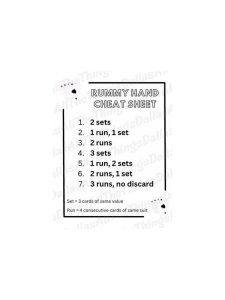
Use three comparisons. First, count the remaining cards each route needs. Second, list what would break if you changed course. Third, ask whether the route fits the format’s declaration requirements. A nearly complete group that leaves a compulsory requirement unmet may be less valuable than it appears.
Timing changes the balance. Early in the hand, flexibility can justify keeping a connector while the table is still unknown. In the middle, confirmed groups become more important because they reduce the number of unresolved tasks. Near the end, visible progress usually deserves priority unless it blocks a necessary sequence or creates a serious point risk.
A useful practice exercise is to pause after a draw and write two sentences: “My visible progress is…” and “My flexible potential is…”. Then name one card that supports each. This separates an emotional preference for a neat group from a reasoned assessment of the whole hand.
Neither approach wins automatically. Strong play often combines one dependable anchor with a limited amount of flexibility. Keep the comparison specific, update it after new information, and accept that a sound decision can still meet an unfavorable draw.
As a review exercise, pause at the same hand position and write one sentence defending each approach. Then list the missing requirement for both. This makes the trade-off concrete and shows whether the flexible plan is genuinely adaptable or merely unfinished.