Rummy Tips: Compare Two Unseen Card Assumptions
Rummy players often think about cards that have not appeared yet. That is useful, but an unseen card should remain an uncertainty rather than becoming an imaginary possession. A simple comparison method helps you notice when two routes are both possible but only one has a sensible dependency.
Start by writing the two assumptions in plain language. For example, Route A may need one card of a particular rank in a suit, while Route B may need either of two ranks but also requires keeping a high-value card. Avoid describing both routes as “likely.” List the exact missing cards and the cards you would have to keep while waiting.
Next, compare breadth. A route with two useful replacement cards has a wider target than a route with one. Breadth is not a guarantee, because other players may hold or discard relevant cards, but it is a useful first measure. Then compare cost. If waiting for Route A leaves several unconnected high cards in your hand, its apparent simplicity may be misleading. Route B may be less elegant but safer because it keeps the total exposure lower.
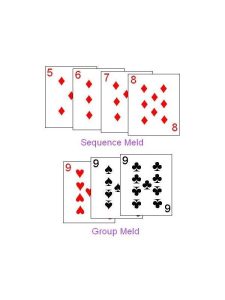
The third comparison is flexibility. Ask whether a failed draw leaves the cards in a useful position. A card that supports a second sequence, a set, or a safe future discard has more fallback value than a card that serves only one narrow pattern. A route with fewer targets can still be preferable if its failed components remain useful.
Finally, separate evidence from expectation. Visible discards can change the practical value of an unseen card, but they do not prove where every remaining card is. Use phrases such as “two visible targets remain” or “no target has appeared yet,” rather than “the card must be coming.” This language keeps the calculation honest.
When comparing the routes, choose the one with the better combination of target breadth, replacement cost, and fallback value. If the difference is small, use a low-risk discard as a tie-breaker and reassess after the next draw. The point is not to predict the deck perfectly. It is to prevent a single unseen card from controlling the entire hand without a clear reason.
This comparison also helps when the table pace is fast. Prepare the two routes during the sorting step, then revisit only the facts that changed after the draw. If one route now has a confirmed group or a lower-cost discard, it may deserve priority even if it was not the original favorite. If neither route improves, avoid inventing a third route merely to escape uncertainty. Make the smallest sensible change and set a clear review point for the next turn.